
Buying guide
How Much Car Can I Afford in Canada? A Realistic Budget Guide
Work back from the monthly cost
Your car budget has to cover the payment and the cost of using the car. Start with what is available after your other bills and savings, then subtract insurance, fuel, maintenance and parking. What remains is the payment you can work with.
In the example below, a $1,000 monthly budget leaves $370 for a loan payment. With $5,000 down and a five-year loan at an assumed 7%, that works out to about $21,000 before tax for an Ontario purchase, before allowing for licensing and other costs.
The affordability calculator does this calculation with your figures. You can start with take-home pay and spending, or choose “A car budget I already have.” Its purchase-price estimate uses Ontario HST; the budgeting approach works across Canada, with the tax calculation adjusted for where and how you buy.
Start with what is actually available
Use monthly take-home pay, then account for housing, groceries, utilities, debt payments, childcare, savings and the other spending you intend to keep. Two households on the same salary can have very different amounts left for a car. FCAC's budget guide uses income, expenses and savings as the starting point.
When replacing a car, take its ongoing payment and running costs out of the old budget before adding the new car's costs. Handle any remaining loan payoff separately in the purchase calculation.
If you are adding a second car, keep the first car's costs in the household budget. A $1,000 allowance for both vehicles cannot fund $1,000 of spending on each. Divide the amount between them before comparing prices.
Leave yourself the monthly cushion you want. If the numbers leave nothing for a payment, the budget does not currently support a new loan.
A $1,000 car budget, line by line
Here is a sample monthly budget. These are example amounts, not Canadian averages:
| Monthly allocation | Amount |
|---|---|
| Available for this car | $1,000 |
| Insurance | −$200 |
| Fuel | −$180 |
| Maintenance and tyres | −$100 |
| Parking | −$50 |
| Money left uncommitted | −$100 |
| Available for the payment | $370 |
That $370 payment supports about $18,686 of borrowing at an assumed annual rate of 7%, divided into monthly periods, over 60 months. Add $5,000 cash down and there is about $23,686 for the purchase including tax.
For an Ontario dealer purchase with 13% HST and no trade, dividing that amount by 1.13 gives about $20,961 before tax. Licensing and any other costs paid from the same funds reduce that vehicle-price budget. CRA explains the applicable GST/HST rates.
The rate and down payment are part of this example. Use the terms you are actually being offered when comparing cars.
To try it in the calculator, choose the existing-budget option and enter $900, with the $100 cushion already set aside. Open the running-cost and loan details, enter the costs above, then use monthly payments, 7%, 60 months and $5,000 down. Enter your licensing cost as well.
What if insurance costs more?
Keep the same budget, down payment and loan terms, but raise insurance from $200 to $300 a month:
| Result | $200 insurance | $300 insurance |
|---|---|---|
| Available payment | $370 | $270 |
| Amount the payment supports borrowing | About $18,686 | About $13,636 |
| Purchase funds with $5,000 down, including tax | About $23,686 | About $18,636 |
| Ontario price before HST, with other costs still to come | About $20,961 | About $16,492 |
An extra $100 a month in insurance cuts the pre-tax purchase budget by roughly $4,469 in this example. Getting an insurance quote early can change the shortlist considerably.
Use real running costs where you can
Insurance: get a quote for the vehicle, drivers, address, use and coverage. Carry that amount into the budget rather than assuming the new car will cost the same as the old one.
Fuel: use your annual kilometres, the car's consumption in litres per 100 kilometres and the price of the fuel it needs. NRCan's ratings search lets you look up Canadian models and configurations.
For a sample gasoline calculation, 15,000 km a year at 8 L/100 km and $1.80 per litre costs $2,160 a year, or $180 a month:
15,000 ÷ 100 × 8 × $1.80 ÷ 12 = $180.
For an EV, budget charging from electricity use and the prices you expect to pay at home and away. A plug-in hybrid needs both fuel and charging costs. The hybrid-versus-gas guide covers comparing annual fuel bills.
Maintenance and tyres: use the service schedule, the car's condition and local prices. Turn periodic bills into a monthly amount you set aside. Include tyre replacement, seasonal changes or storage if you will pay for them.
Parking and tolls: use your actual commute and regular trips. Add workplace parking, a residential space or tolls where they apply.
Revisit the budget when a quote replaces an estimate. The calculator's starting figures are editable; your own costs determine the result.
A longer loan lowers the payment—and keeps it around longer
Here is the same $40,000 loan at an assumed 7% annual rate over four different terms. These are loan amounts, not advertised vehicle prices. All payments are monthly, with no added fees.
| Loan term | Monthly payment | Total interest |
|---|---|---|
| 48 months | $957.85 | $5,976.79 |
| 60 months | $792.05 | $7,522.88 |
| 72 months | $681.96 | $9,101.14 |
| 84 months | $603.71 | $10,711.40 |
Going from 60 to 84 months lowers the payment by $188.34, adds $3,188.52 in interest, and leaves you making payments for another two years. Totals are calculated before rounding the displayed payments.
Also consider when you expect to sell. After payment 48, the 60-month loan still has about $9,154 owing. The 84-month loan has about $19,552 owing. Compare the balance at your planned sale date with a range of possible vehicle values.
If the sale proceeds fall short of the loan payoff, you have negative equity to cover. FCAC explains how longer loans can extend that gap.
Use the payment calculator to compare the terms in your quotes. Keep the price, down payment and extras visible alongside the payment. For leasing, the lease-versus-finance guide includes what you own or owe at the same end date.
Down payments and trade-ins
Choose the cash you want to put into the purchase after deciding what to keep available for other needs. A larger down payment reduces borrowing, but it also moves money out of your account and into the car.
With a trade, get the allowance and lender payout separately. A $15,000 trade with $10,000 owing gives you $5,000 of equity before considering the replacement purchase's tax treatment. A $15,000 trade with $18,000 owing leaves a $3,000 shortfall.
The trade-in versus private-sale guide compares the full contribution from each route. The Ontario taxes and fees guide shows how the allowance, old loan and deposit enter the final quote.
If the car you want is above the budget
Compare a lower trim, a smaller vehicle or a used alternative. Price its insurance and likely upkeep too; a lower sticker price alone does not settle the monthly comparison.
Use the new-versus-used cost worksheet to compare those alternatives over the years you expect to keep the car.
If space is the reason for moving up a size, try the actual passenger and cargo fit. The Kona-versus-Tucson comparison lays out those checks. A larger vehicle earns its extra cost when it solves a need you actually have.
Keeping the current car is another option. Compare its payment, expected repairs and running costs with the replacement. Waiting can also give you time to pay down the old loan or save a larger deposit.
If you owe more than the car is worth, the financed trade-in guide shows how that gap enters the next purchase.
Common questions
How much should I spend based on my salary?
Start with take-home pay and the spending you already have. A salary-based percentage cannot account for your rent, debts, savings or a second household vehicle. The amount left after those commitments is the useful starting number.
Should depreciation go in my monthly budget?
Use the loan payment when working out cash leaving your account. For a longer-term ownership comparison, use purchase price minus resale value, plus interest and running costs. Adding full loan payments and full depreciation to the same total counts the vehicle's cost twice.
How do I compare a biweekly payment with a monthly budget?
Multiply a regular biweekly payment by 26, then divide by 12. A $300 biweekly payment averages $650 a month, not $600. Twice-monthly payments are a different schedule, with 24 payments a year.
What if I can get approved for more?
Approval tells you what a lender is prepared to lend. Your budget tells you how the payment fits with everything else you pay for. Keep the shortlist within the total you chose.
Take a complete budget shopping
Write down your pre-tax price range, cash down, payment limit, loan term and running-cost estimates. Compare each quote with those same numbers.
Use the affordability calculator to work out the range, then the car-buying checklist below to add your passenger, cargo and driving needs.
Take that budget with your dealership visit checklist. The Ontario buying guide follows the next steps from comparing quotes to pickup.
Keep reading
Hybrid vs. Gas in Canada: Is a Hybrid Worth the Extra Cost?
A hybrid earns back its extra cost when fuel savings catch up with the price premium. Compare your kilometres, purchase prices and years of ownership to see when that happens.
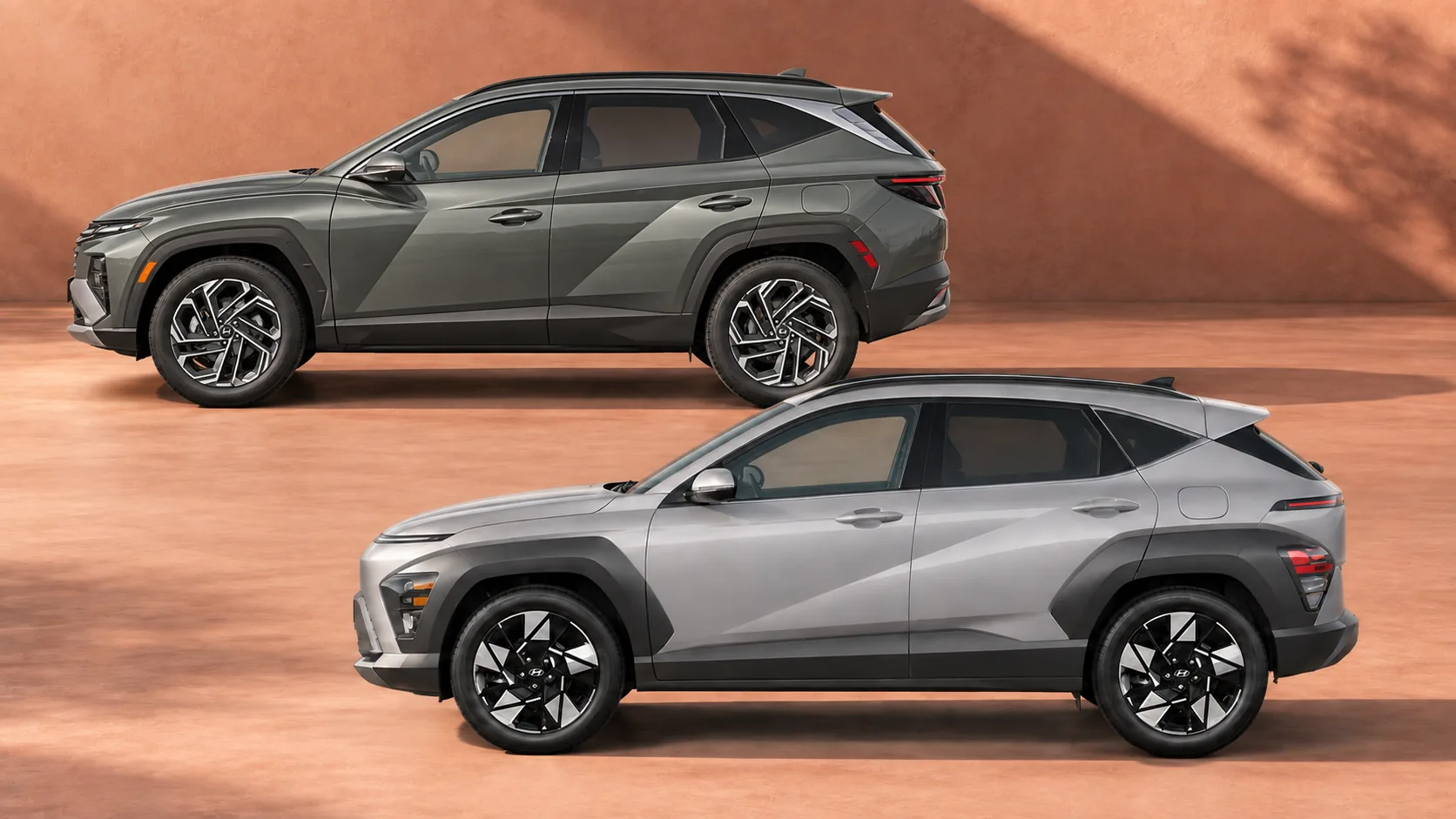
Hyundai Kona vs. Tucson in Canada: Do You Need the Larger SUV?
Start with the Kona if it fits your passengers and regular cargo. Compare the Tucson when extra room solves a daily problem, then put the upgrade cost beside that benefit.